
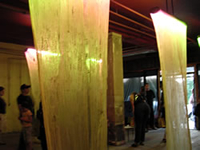

For decades the neo-avante gaurde has been devising new vocabularies and tools to define the public and private arena of the urban landscape. The prosaic objects that saturate everyday life are a constant theme in the work of contemporary artists. Since the beginning of May 2004, the public and private space of Louisville, Kentucky has been snowed by the Brood X cicadas. Sharon Scott's work simultaneously raises natural, geographical, and sociological questions, and brings it together under the opus of the installation Brood X: in-between spaces.
Installation art is an experimental activity, invoking creation of unanticipated places and environments in which visual and intellectual habits can be challenged and disrupted. It moves beyond the physical boundary of a single space into a realm of negotiated interactivity and simultaneity.
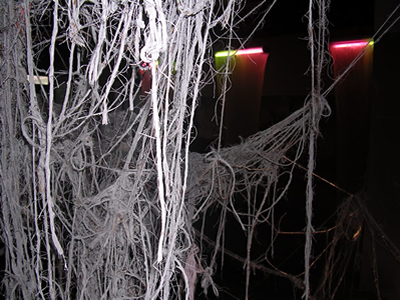
The vacant area of 744 E Market Street becomes a transformed vastness or territory that connotes the realm of a natural ritual that occurs every other decade. Scott appropriates the image of the cicada through the parameters of sculpture. The artist does not literally replicate the event that occurs every seventeen years, but takes a step further to investigate connections to this phenomenon. The relations always begin with our associations, constituting a subjective reality and questioning what a cicada might signify: fear, specific roles during mating rites of metamorphosis from a private secluded underground world into that of a public one.
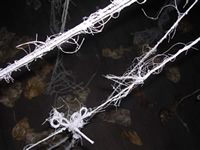
In the formal approach the artist parallels the layering of the cicada itself. The sculpture is initiated by a strand of metal support, on to which layer after layer of paper sheets are added. Once the paper is cast to the original form, additional coats of epoxy resin are supplemented as a protective covering. After the resin is dry, an epidermal outer garment is applied as a final fold.
Like many installation artists, Scott finds means to advance the work beyond the purely formal appearance and incorporates technological aspects, such as recorded sound. The alliance between the sound and the object transforms the vicinity into an experimental locality, giving rise to more that just the sensation of sight. Resonance occupies a salient space in the exhibition, slipping away from the materiality of an artwork, yet giving force to the overall environment.
The discourse of Brood X: in-between spaces investigates the relationship between the artist's work and the onlookers with a specific leitmotiv. Scott sets the stage for the observer, with the potential for the oeuvre to augment and progress. It all depends upon how curious and participatory the audience wishes to be, in order to plunge into the artist's world. As Robert Storr writes: "Every choice we face - to cross the threshold of the installation or just peak in to linger or to hurry, to acknowledge fellow spectators or ignore them - complicates the basic aesthetic question. At every turn we must fall back on our own intuitions and examine our own responses. Active participants rather than passive onlookers, we set the artist's world in motion and give it meaning."*
The constructed locality i.e. the Brood X: in-between spaces installation deconstructs the strict binary separation between the creator and the spectator, private and public, in order to create a more fluid in-between space. Scott's idea of installation is not a passive one, as in a spectacle, it involves action and creation on behalf of the viewer. Her strong sense of personal freedom as an artist coincides with her vision of audience reciprocation with the site-specific work.
Ultimately, what concerns Sharon Scott is not to present the reality behind the cicada. We are never given reality in its naked state anyway, everything is an interpretation, or an interpretation of an interpretation. Each one of these sculptures, hard outer coverings or gauzy incubator-like settings are a trap for the imagination - so introduce a cicada shell and add an interpretation to the installation.
- Boshko Boskovic